

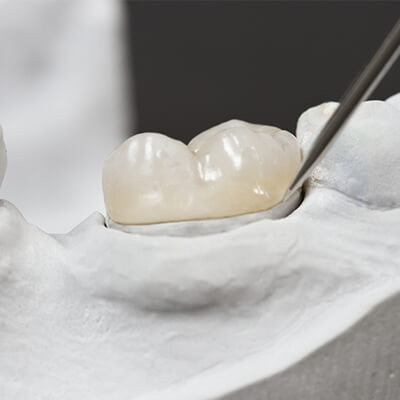
What is a dental inlay?
A dental inlay is a custom-made restoration that fits within the cusps of a back tooth. It is generally used when a tooth has more extensive damage than can be reliably repaired with a conventional filling, but enough healthy tooth structure remains to avoid the need for a crown.
Inlays are made to fit the prepared tooth precisely and can restore its strength, shape and function.
What is a dental onlay?
A dental onlay is similar to an inlay but extends over one or more of the tooth's cusps. It is therefore suitable for teeth where a larger area needs to be restored.
An onlay can restore a weakened or damaged back tooth while preserving healthy tooth structure that may otherwise need to be removed when preparing the tooth for a crown.
When might an inlay or onlay be recommended?
Your dentist may recommend an inlay or onlay when:
- A back tooth has extensive decay
- A large filling has failed or needs replacing
- A tooth has been cracked or damaged
- A large filling has weakened the remaining tooth
- There is not enough healthy tooth structure for a conventional filling
- An inlay or onlay could provide a suitable alternative to a crown
Every tooth is different, so your dentist will examine the tooth and assess the amount of healthy structure remaining before recommending the most appropriate treatment.
Inlays and onlays vs fillings
Small areas of tooth decay or damage can often be treated successfully with a conventional filling. However, when a larger area of a back tooth has been damaged, a filling may not provide the strength or stability required.
An inlay or onlay is custom-made to fit the tooth and can provide a strong and precise restoration for more extensively damaged teeth.
Your dentist will recommend the most appropriate option based on the condition of your tooth and your individual needs.
Inlays and onlays vs crowns
A crown covers the entire visible portion of a tooth, whereas an inlay or onlay restores only the damaged area.
In suitable cases, an inlay or onlay can preserve more healthy natural tooth structure than a crown. However, when a tooth is extensively weakened or damaged, a crown may provide the additional protection required.
The most appropriate treatment depends on the amount of healthy tooth structure remaining, the condition of the tooth and your bite.
What happens when you have an inlay or onlay?
1. Assessment
Your dentist will examine the tooth and assess the extent of any decay, cracks or existing restorations. We will explain the available treatment options and recommend the most appropriate solution.
2. Preparing the tooth
Any decay, damaged tooth structure or old filling that needs to be removed is carefully treated. The tooth is then prepared to receive the new restoration.
3. Impression or digital scan
An impression or digital scan of the prepared tooth is taken so that your inlay or onlay can be custom-made to fit accurately.
4. Temporary restoration
If required, a temporary restoration may be placed to protect the tooth while your permanent inlay or onlay is being made.
5. Fitting your inlay or onlay
At your second appointment, the completed restoration is carefully checked for fit, appearance and bite. Once everything is satisfactory, it is securely bonded into position.
We will make sure your bite feels comfortable and that you are happy with the appearance of your restored tooth.
Benefits of dental inlays and onlays
Inlays and onlays can offer a number of benefits when they are appropriate for the condition of the tooth:
- Preserve healthy natural tooth structure
- Restore damaged or weakened back teeth
- Provide a strong and durable restoration
- Custom-made for an accurate fit
- Restore normal chewing function
- Provide a natural-looking appearance
- Can be used to replace large or failing fillings
- May provide a conservative alternative to a crown in suitable cases
Materials used for inlays and onlays
Inlays and onlays can be made from different materials. The most appropriate material depends on the tooth being treated, the amount of tooth structure remaining, your bite and your aesthetic preferences.
Tooth-coloured inlays and onlays
Tooth-coloured restorations can be designed to blend naturally with the surrounding teeth. They can provide an attractive option where appearance is particularly important.
Gold inlays and onlays
Gold has traditionally been used for back-tooth restorations because of its strength and durability. Although it does not have the same tooth-coloured appearance as other materials, it can be an excellent option in appropriate cases.
We will discuss the available options with you and recommend the most suitable material for your tooth.
How long do inlays and onlays last?
The lifespan of an inlay or onlay depends on several factors, including the material used, the condition of the tooth, your bite, oral hygiene and how well the restoration is maintained.
Good brushing, regular dental check-ups and professional dental hygiene appointments can help maintain the health of the tooth and surrounding gums.
If you notice any discomfort, sensitivity, movement or damage to an inlay or onlay, contact us so that we can assess it.
Frequently Asked Questions
Are inlays and onlays better than fillings?
An inlay or onlay may be recommended when a tooth has more extensive damage than can be reliably restored with a conventional filling. Your dentist will assess the remaining tooth structure before recommending the most appropriate option.
Are inlays and onlays better than crowns?
Neither option is always better. An inlay or onlay can preserve more natural tooth structure when there is sufficient healthy tooth remaining, while a crown may be more appropriate when a tooth is extensively weakened or damaged.
Do inlays and onlays look natural?
Tooth-coloured inlays and onlays can be made to closely match the appearance of your surrounding teeth, providing a natural-looking restoration.
Are inlays and onlays painful?
The tooth is normally treated under local anaesthetic, so you should not experience significant discomfort during the procedure. Some sensitivity or mild discomfort may occur afterwards while the tooth settles.
How many appointments are needed?
In many cases, treatment is completed over two appointments. During the first appointment, the tooth is prepared and an impression or digital scan is taken. A temporary restoration may be placed while the permanent inlay or onlay is made. At the second appointment, the completed restoration is checked and securely fitted.
How much do inlays and onlays cost in Richmond?
The cost depends on the tooth being treated, the extent of the damage and the type of restoration required. We will assess your tooth and provide you with a clear treatment plan and cost before treatment begins.
Can an inlay or onlay replace a crown?
In some cases, yes. An inlay or onlay may be suitable when sufficient healthy tooth structure remains. If the tooth is extensively weakened or damaged, a crown may provide better protection. Your dentist will discuss the options with you after assessing the tooth.
Why choose Kew Road Dental for your inlays and onlays?
A warm welcome
Our friendly and attentive reception team are here to make your visit comfortable from the moment you arrive.
Personalised dental care
We take the time to understand your needs and recommend the most appropriate treatment for your tooth, your oral health and your long-term dental goals.
Experienced dental team
Our experienced dentists provide careful, patient-focused treatment, with your comfort and the health of your natural teeth at the centre of your care.
0% finance available
We offer 0% finance on eligible treatments from £500, helping you spread the cost of your dental treatment.
Highly rated by our patients
We are proud to be highly rated by our patients on Google, reflecting our commitment to friendly, professional and personalised dental care.
Book an inlay or onlay consultation in Richmond
If you have a damaged, cracked or heavily filled back tooth, an inlay or onlay may provide a strong and natural-looking way to restore it.
Contact Kew Road Dental in Richmond to arrange a consultation. We will assess your tooth, explain your treatment options and help you choose the most appropriate solution for your dental health.
Call us on 0203 667 6235 or get in touch to arrange an appointment.